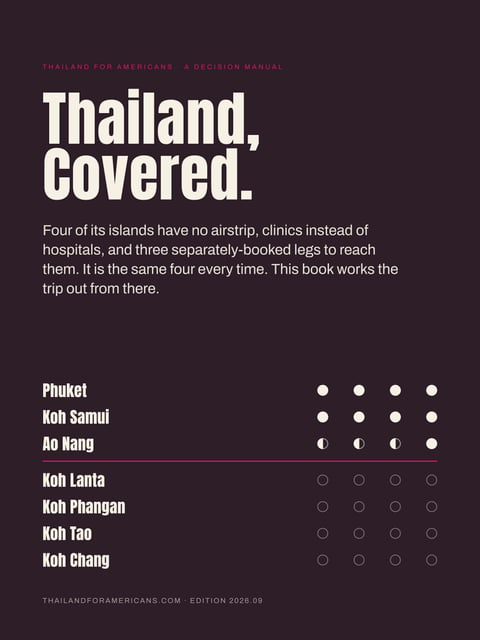
Thailand, Covered.
Every system in Thailand has a line where it stops working — and the lines all fall on the same four islands.
The free articles here answer the questions. This joins them into the sequence the questions never see — and it is decided at booking, weeks before anyone is standing on a pier.
One decision in here is the difference between a claim paid and a claim denied in full — against surgery that runs into the tens of thousands of dollars at a Thai private hospital. It is settled at home, before you fly.
Before you book a Bangkok hotel
The free articles below answer each step on their own. The decision manual is what connects them — the exception at each join, and what to do once it applies to you.
- 1
- 2Which line actually reaches it
A cheap room off the BTS/MRT grid buys back nothing — you pay it back every day, in traffic.
- 3What it costs to move once you're there
The daily fare adds up differently depending which side of the grid you picked.
Three ways a good plan goes wrong
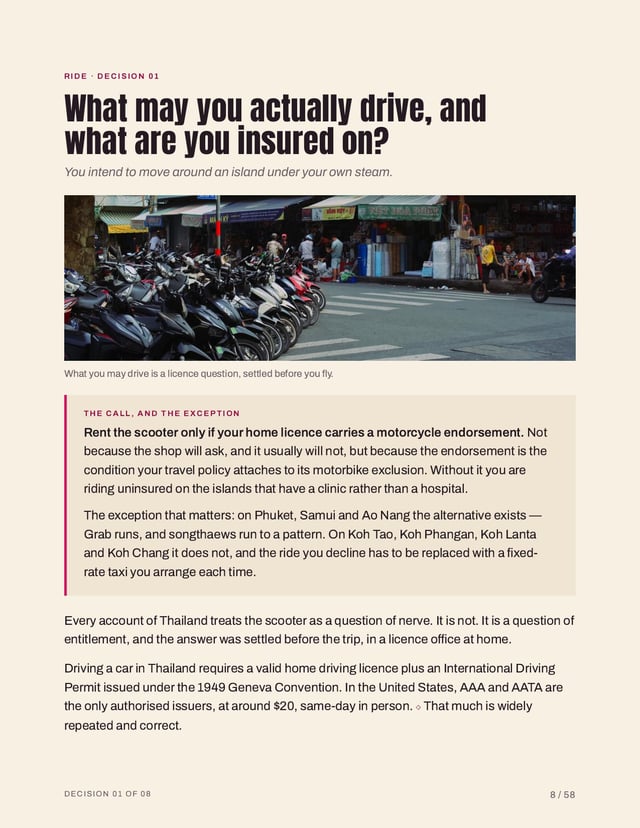
The rental shop hands over the scooter without looking at your licence. The claims assessor looks at all of it — and a motorbike clause is usually conditional on an endorsement most American licences do not carry.
A private hospital wants payment, or a guarantee of payment, before it bills you. That guarantee comes from your insurer’s assistance line, and arranging it is the call almost nobody makes in time. Emergency first, always — but make that call before the billing is settled, or you finance the emergency yourself.
A crossing is suspended the morning you fly home. Your legs were booked separately, so no one owes you a rebooking — and the nights that would have absorbed it had to be bought months earlier.
None of these is exotic. Each one is decided weeks early, in a browser tab that never meets the others.
The questions it actually answers
- What may you actually drive, and what are you insured on?
- How many islands actually fit, and in what order?
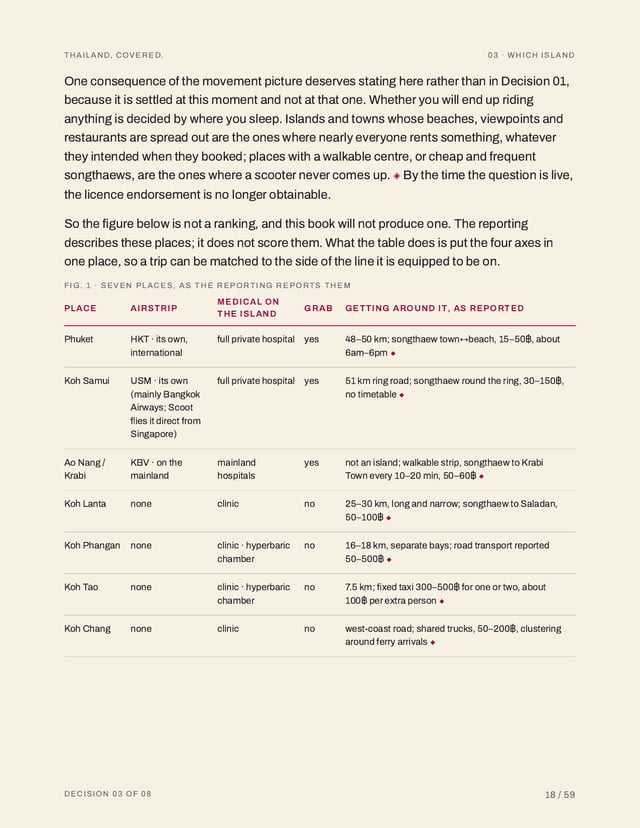
- Which island — and which side of the line?
- How do the legs connect, and who owns the failure?
- What are you exposed to, and what does a policy actually answer?
- Bangkok: where do you sleep, and how do you cross it?
- The temple door, and the elephant question
- Ordering well, without a reservation system you can use
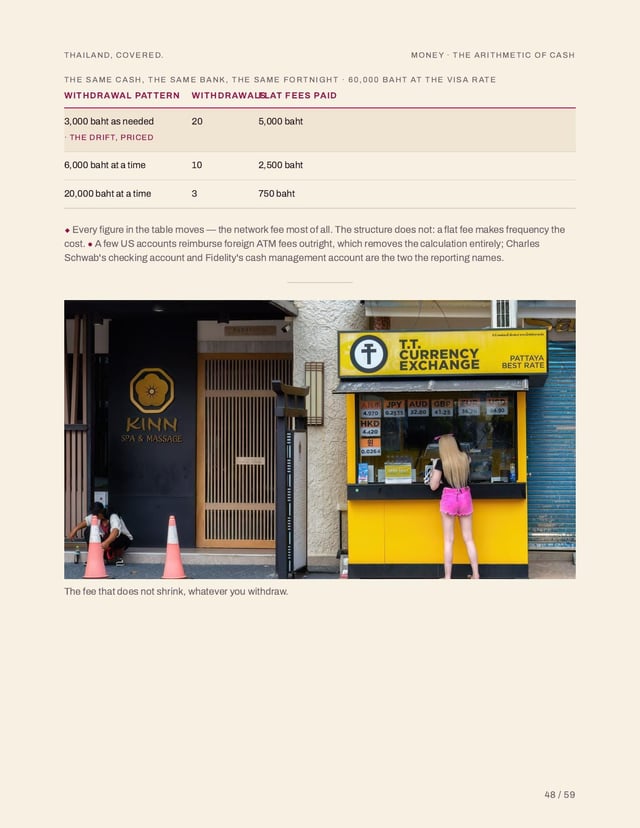
Each one is answered with the arithmetic shown — the fares, the day counts, the transfer hours — so you can run the sum on your own trip and disagree with the verdict on purpose rather than by accident.
Every claim carries its provenance
Each load-bearing statement is marked for where it stands: established across independent sources, official (read on a government, embassy or airport-authority page), surveyed by us with the method stated, or volatile. Nothing that could not be pinned made the page — several sharp-sounding numbers were cut for exactly that reason, including one that two research models were happy to supply.
What it refuses to do
- No restaurant names. A named restaurant is a guess with a byline that rots in a season. The rule for finding the right one is free on this site and true for years.
- No hotel picks. A property is stale in a season. Which side of the lines you sleep on is the decision that does not expire — and that one is in the book.
- No insurer named. The anatomy of a policy is stable; the ranking of providers is a market we would be guessing at. You get the compartments to demand and the questions to ask.
- No prices printed in the prose. Anything that moves lives on the Field Sheet, dated, with where to re-check it.
The part that expires, kept separate
The book holds the analysis, which is stable for about two years. The Field Sheet holds what moves — fares, fees, filing windows, last departures — each with its date and the official place to confirm it in your travel week. It is refreshed quarterly and it ships with the book. That division is why the book can afford to be honest about how long its own claims last.
What arrives, and when
Both files are PDFs, and they arrive the moment the payment clears — nothing is posted, nothing is drip-fed, there is no account to make. Read them on a phone or print them; the book is laid out for paper at 59 pages.
Because it is delivered whole and at once, a sale is final. That is why real pages are shown below before you spend anything — not a cover, not a contents list, actual spreads with the arithmetic on them. Read them first.
The book (59 pages) + the current Field Sheet — $14.99, about the cost of one airport transfer you did not need.